Compound Disadvantage
Wait and see, like hope, is not a strategy


The brutal maths of delay
When people think about AI advantage, they think about one-off efficiency gains. One person doing the work of two. A proposal written in an hour instead of a day. I’d argue that this is the wrong way to think about it. Implicit in that analysis is that AI gains are linear. But they aren’t. Like compound interest, when you started matters enormously, because the firms that started earliest are now building a lead that is getting increasingly hard to match.
Here is what compounding looks like in practice. A consultancy that embedded AI into its research, proposal, and delivery workflows twelve months ago has not just saved time. It has run more projects, generated more proprietary data, refined its processes through hundreds of real engagements, and built institutional fluency in a way of working that did not exist before. Its people have developed judgment about where AI helps and where it confidently produces nonsense. That judgment does not exist in a firm still in pilot mode, waiting for the technology to “mature.”
There is a talent dimension to this too. Professional services staff everywhere are watching to see what AI means for their careers. They know the line: ‘AI won’t take your job, but someone using AI will’. So their interests are best served by working somewhere that gives them the deepest grounding in it, the place where they become the master of AI rather than it becoming the master of them. The firms building genuine AI capability are already placed to win that talent competition.
So the gap between the two firms is not twelve months of productivity savings. It is twelve months of accumulated capability, plus a talent base that chose them for a reason. The early movers become predators. The late movers become prey. And the economic divergence between them compounds further still, to a point where it may no longer be possible to compete on the same terms.
Why catching up is harder than it looks
The natural assumption is that AI is a technology, and technologies can be acquired. You sign up for the same tools, hire a consultant, appoint a Head of AI, run an “AI transformation programme,” and close the gap. That is true for infrastructure. It is not true for capability.
What a genuinely AI-fluent firm has that a late adopter does not, is judgement. Immature firms and users ask AI to do the work and accept the answers. Mature firms treat AI as a series of specialist workers for the routine things and expert thought-partners for the complex, reputation-defining work. Staff in mature firms don’t outsource creativity and judgement. Their business thrives on surprising, thought-provoking work. That work will have been produced by people in partnership with AI. People who know when to trust the output and when to push back. They will have cultural permission to work differently. They will have a quiet confidence that comes from having done it, repeatedly, in anger. You can’t buy that, only earn it.
Time arbitrage is brutal
There is one more uncomfortable truth. The tools themselves are not standing still while firms deliberate.
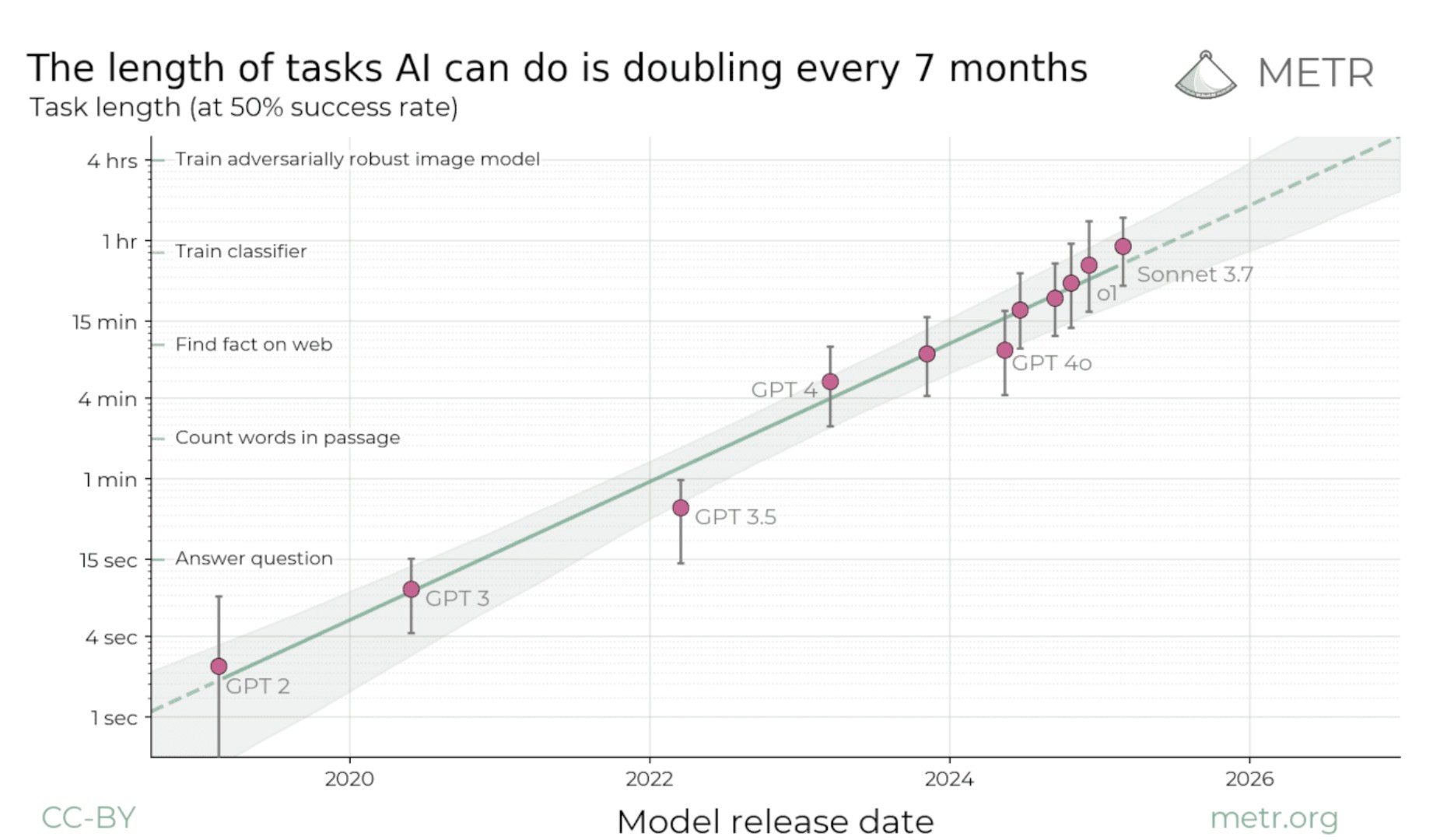
Rate of increase in LLM capacity. Source: METR
Research firm METR found that the length of tasks AI can complete autonomously has been doubling every seven months. Think about that. Moore’s Law has driven a doubling of computer chip power every two years since the 1960s and we thought that was fast. This new power law will lead to a **35x** increase in task complexity that can be handled over the next three years. That’s hardly an incremental change, it’s total transformation of cognitive work. And it’s self-fulfilling: the models are now so capable that they are significant actors in their own development, each generation accelerating the next. Combine that with the explosion of practical agent tooling and you have clear blue water opening ahead for organisations that are genuinely embedded in this. For those that aren’t, the current advantage gap will look modest compared to where it sits in eighteen months.
What this means for agency and consultancy leaders
If you are running a professional services firm and you do not yet have a clear picture of where AI sits inside your delivery model, you are not at the starting line. You are behind it.
Not only is that not a criticism, I would argue that it’s a logical place to be if you think that AI is like every other tech fad you’ve seen (Web 3.0, blockchain anyone?). Plus, the past two years produced genuine confusion about which tools matter, which vendors will survive, and how to move without creating risk. The result: much AI debate has been riven with cautionary tales that are two or three years old and simply do not reflect today’s tools. Caution was rational.
I’ve watched enough transformation programmes to say this plainly: I fear that not making this top priority now will turn out to be terminal for many. So much evidence has accumulated that the risks of not getting involved are now substantially higher than the risks of carefully embracing this. This has moved beyond “are we using AI?” Most firms can tick that box. The harder question is: is AI an individual tool making your people more marketable elsewhere, or an institutional tool making your business more competitive and more valuable? Where has it changed what your people do, not just how fast they do it?
We know from the Thomson Reuters data that 87% of professionals say AI is not yet central to their workflow. Statistically, you are likely to be in that 87%. The firms in the 13% have started ahead of you, and they are speeding up.
What this means for owners and investors in professional services firms
A firm that has genuinely embedded AI into its delivery model is a different asset from one that has bolted on a few tools and put “AI-enabled” in the top left corner of the investor deck. The former has margin expansion, scalable capacity, defensibility, and an operational story a buyer can underwrite. The latter has a slide.
This is now a multiple-affecting factor, not just an efficiency story. The spread between what a genuinely AI-native professional services firm commands at exit and what a late-stage converter commands is already visible, and it will widen.
The assessment question that matters is “what has changed about how this business works, and what would it cost a buyer to replicate that?” If the answer to that question is “not much,” the AI story is decoration.
Around 40% of firms made no AI investment in 2025 at all. For a PE partner reading this, the question is simple: how many of those are yours?
The only question that matters
The AI advantage is not waiting to be unlocked by the right strategy document, the right hire, or the right moment when the technology finally “settles down.” It is being built, week by week, by firms that committed early and kept going. Their value is now compounding.
The question is not whether to move. It is whether the gap you have already allowed to open is still closeable, and what closing it will actually cost.
Jonathan Peachey is the founder of Factory X, an AI transformation consultancy working with professional services firms and their investors.